Priorities
2. Inventory, cadastre, mapping / digitization of pastures of administrative and geographical territories of the Republic and development of recommendations on sustainable use of pastures
3. Identification of rare plant communities, assessment of their current state and development of protection measures. Preparation of essays of rare communities for the publication of the “Green Book of Uzbekistan
4. Assessment of vegetation cover dynamics under the influence of climate change/desertification, study of the model of future trends in the development of phytocenosis components against the background of climate change scenarios and classification of the state of communities vulnerable to extinction;
5. Creation of an electronic database of existing geobotanical forms and development of an ecological scale of the flora of Uzbekistan.
Achievements of the laboratory
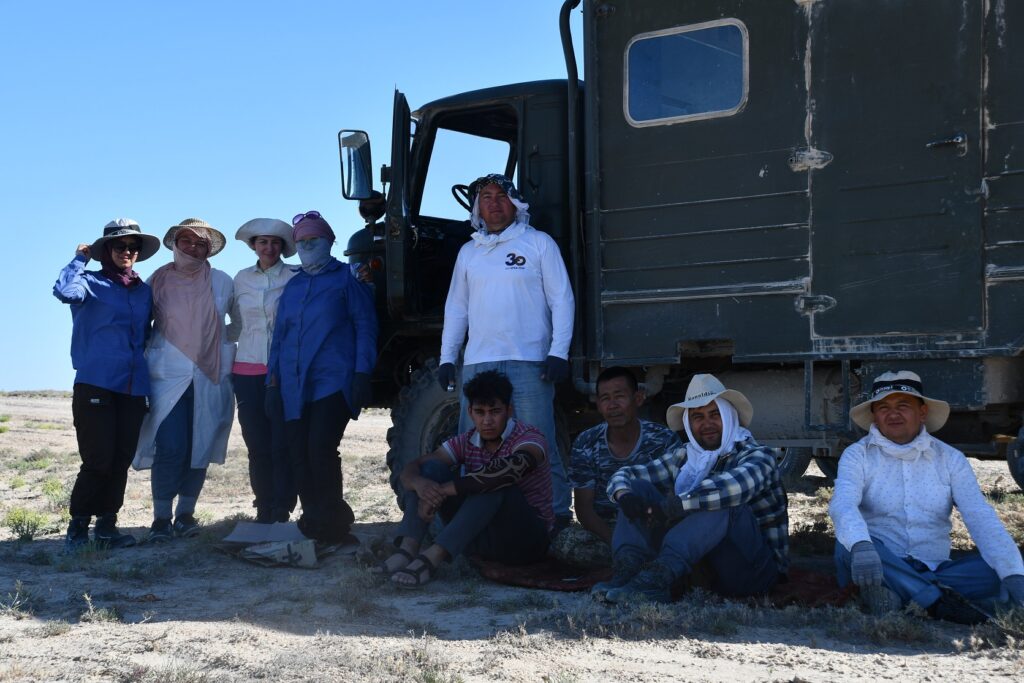
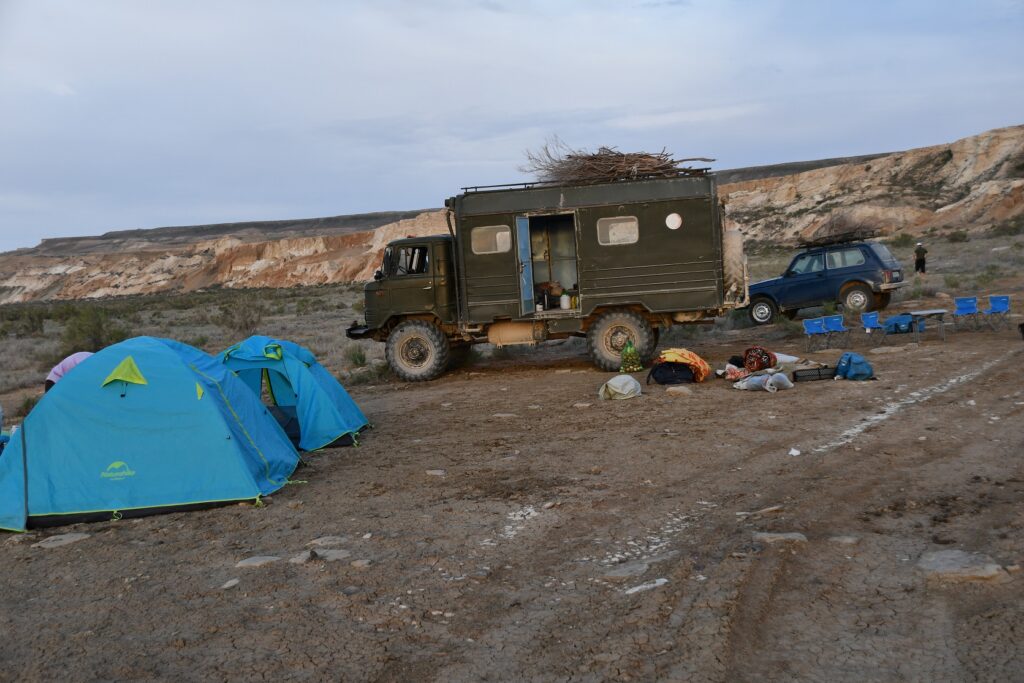
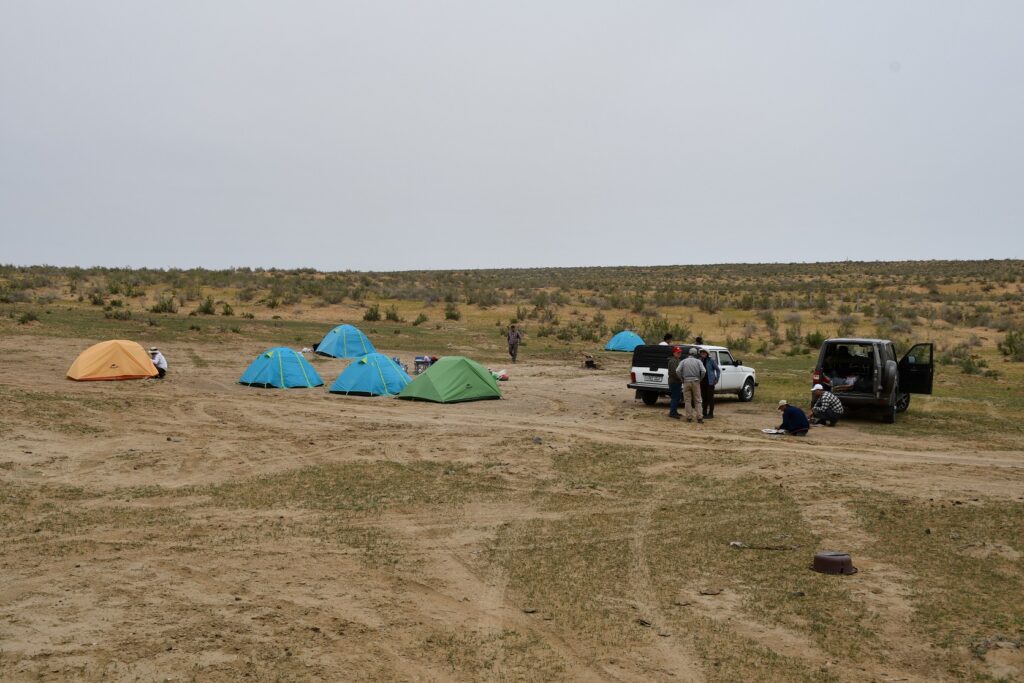
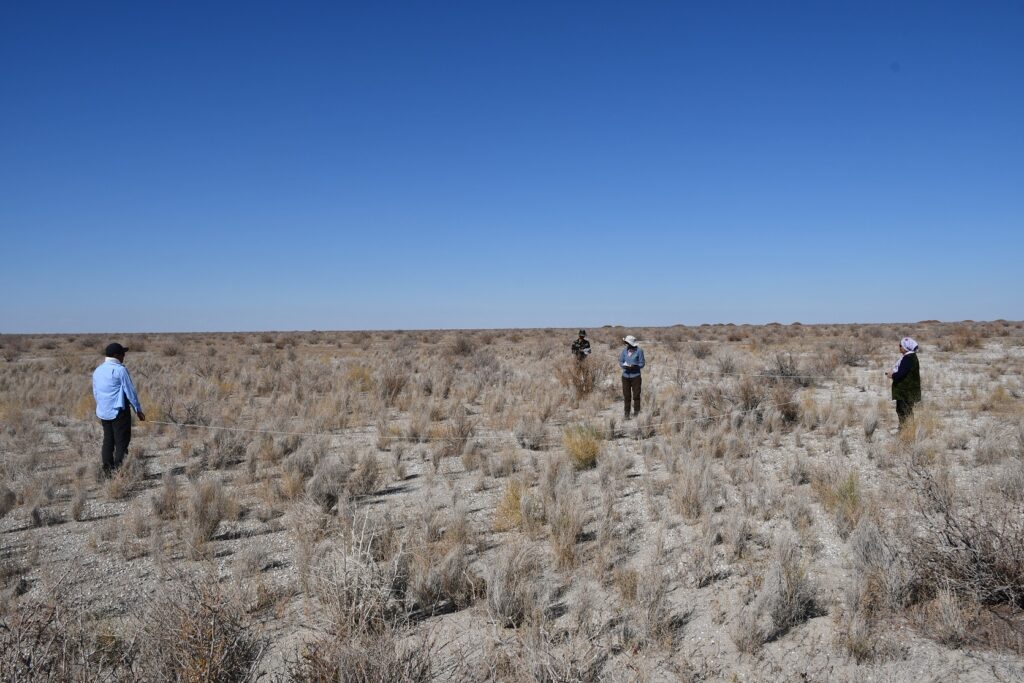
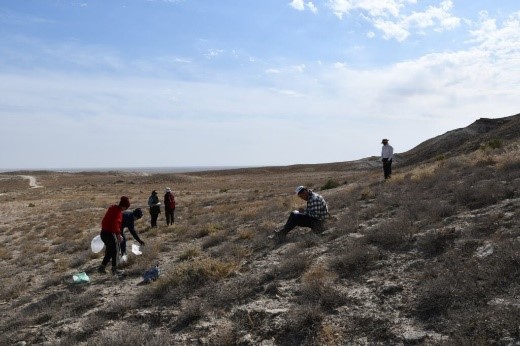
2012-2014 – applied project on the topic: “Assessment of the current state of pasture ecosystems of Central Kyzylkum”. Within the framework of the project, a “Map of the pastures of the Kukcha massif” (M 1:200 000) and a legend to it were compiled. The area and seasonal yield of pasture differences are determined, the degree of degradation of pasture differences is represented by indices A, B, V. In total, 8 types of pastures and 18 cartographic units are identified on the map, 13 of which are pasture differences. The biochemical composition of 17 dominant forage species was revealed. The assessment of the condition of the cenopopulations of rare species Lagochilus inebrians, Lagochilus gypsaceus, Juno hippolyti, Tulipa michaeliana and Tulipa lehmanniana, common in the pasture ecosystems of the Kukcha massif, was carried out. Bioecological features of forage plants were studied at the Kyzylkum desert station, and it was found that 16 of the 40 species continue their long life cycle.
2015-2017 – applied project on the topic: “Assessment of the state of cenopopulations of rare and endangered plant species of the Kyzylkum remnant mountains in connection with desertification”. Within the framework of the project, the current state of 59 cenopopulations of rare and endangered species of the Kyzylkum remnant mountains was studied: Iris hippolyti (Vved.) Kamelin, Astragalus kuldzhuktauense F.O. Khass., Shomuradov & Esankulov, A. holargyreus Bunge, А. centralis E. Sheld., Stipa aktauensis Roshev., Ferula kyzylkumica Korovin, Lepidium subcordatum Botsch. et Vved., Tulipa lehmanniana Merckl., T. borszczowii Regel, T. micheliana Hoog., Eremostachys eriolarynx Pazij et Vved., Scorzonera bungei Krasch. et Lipsch. Their ontogenetic structure and types of cenopopulations are revealed. Based on the selected organismal and population characteristics, the assessment of the current state of the cenopopulations of rare species of Kyzylkum was carried out and distribution maps reflecting the vital state of the cenopopulations were compiled.
2016-2017 – applied project on the topic: “Cadastre of rare and endangered species of vascular plants and vertebrates of Kashkadarya region”. Within the framework of this project, for the first time in the flora of Kashkadarya region, a cadastral list was compiled, including 2,023 species from 617 genera and 103 families. Critical analysis of herbarium specimens revealed the following 12 new species for the flora of Uzbekistan: Chenopodium urbicum L., Halimocnemis beresinii Iljin, Limonium chrysocomum (Kar. &Kir.) Kuntze, Rhodiola recticaulis Boriss., Erigeron andryaloides (DC.) Benth. ex C.B. Clarke. (Psychrogeton andryaloides (DC) Novopokr.), Cousinia pannosa C.Winkl, Pedicularis sarawschanica Regel, Scrophularia canescens Bong., Phlomoides baldschuanica (Regel) Adylov, Kamelin&Makhm., Scutellaria jodudiana B.Fedtsch., Scutellaria poecilantha Nevski ex Juz. and Alopecurus nepalensis Trin. ex Steud. A cadastral list of 88 plant species listed in the Red Book of Uzbekistan has been compiled for the Kashkadarya region. Of these, 39 are national endemics, 1 species is included in the IUCN list, and another 1 species is included in CITES. The current state of the cenopopulations of the species Dianthus uzbekistanicus Lincz., Eremurus robustus (Regel) Regel, Salvia lilacinocoerulea Nevski., Allium jesdianum subsp. angustitepalum (Wendelbo) F.O. Khass. & R.M. Fritsch., Tulipa fosteriana W. Irving и Iris magnifica (Vved.) F.O. Khass. & Rakhimova.
2018-2020 – applied project on the topic: “Cadastre of rare and endangered species of vascular plants of Navoi and Bukhara regions”. Within the framework of the project, a list of vascular plants of the Navoi region was compiled, which included 90 families, 509 genera and 1561 species. The botanical and geographical distribution areas of these taxa in the Navoi region have been determined. Based on the database of the Central Herbarium and literature analysis, a cadastral list of 43 plant species listed in the Red Book was compiled. Of these, 26 species are national endemic. A GIS map of the distribution of species listed in the “Red Book” has been compiled and the ontogenetic structure of cenopopulations of 21 species has been studied. Based on the analysis of existing and updated materials, the state cadastral form of rare and endangered species has been compiled, consisting of the sum of 205 points for the study area.
2017-2020 – a fundamental project on the topic: “Modern trends in the development of vegetation and wildlife of Ustyurt in the process of desertification”. Within the framework of the project, the mechanisms of reconstruction of the plant community of the Karakalpak Ustyurt under the influence of climate change and anthropogenic factors were determined. Based on the analysis of NMDS and Kernel density (f), the nature of the distribution of communities in the process of vegetation cover transformation is shown and an assessment of changes in the vegetation cover of the studied territory in the future is given. In recent years, it has been found that the decrease in the biodiversity index in the mesophytic communities of the Eastern Chink positively correlates with the polydominance index, which is associated with such unfavorable conditions as the drying of the Aral Sea. On the basis of neural regressive and neural cluster analyses, the increase in the contribution of xerophytic and halophytic plants to the species composition of Eastern Chinka communities and their progressive trend in the future (r2=0.03) is justified.
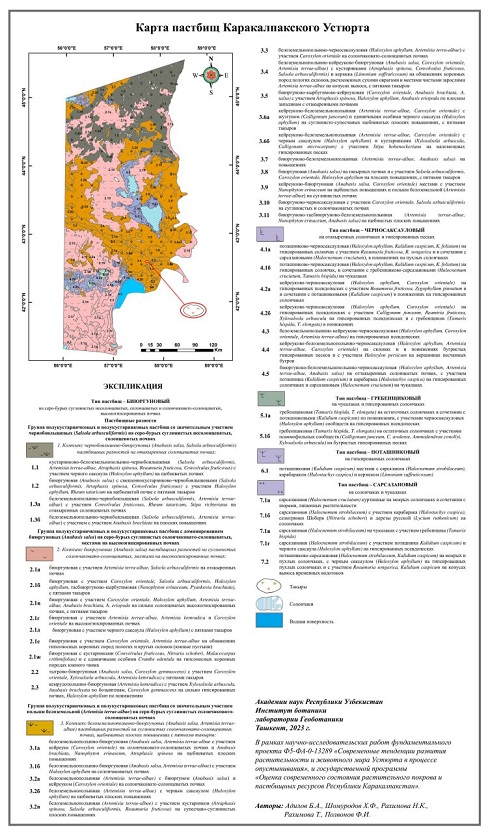
2021 – the state program “Assessment of the current state of vegetation and pasture resources of the Republic of Karakalpakstan”. In accordance with the program plan for 2021, a modern classification of the Karakalpakstan Ustyurt was developed, including 5 types and 37 pasture differences with an area of 7 million hectares. On the basis of the Resolution of the Cabinet of Ministers of the Republic of Uzbekistan dated November 7, 2018 No. 914 “On state accounting, accounting of the volume of use and the state cadastre of objects of the animal and plant world”, for the first time in the republic, the creation of a pasture cadastre was started on the example of the Karakalpak pastures of Ustyurt. Also, on the basis of 20 informative points, a cadastre of 37 pasture differences of the Karakalpak Ustyurt has been developed. 25 rare communities of the Karakalpak Ustyurt have been identified, belonging to such formations as Poaeta bulbosa, Eremopyreta orientalis, Corydalieta schanginii, Calamagrostideta dubia, Medicageta sativae, Agropyreta fragile, Ephedreta distachya.
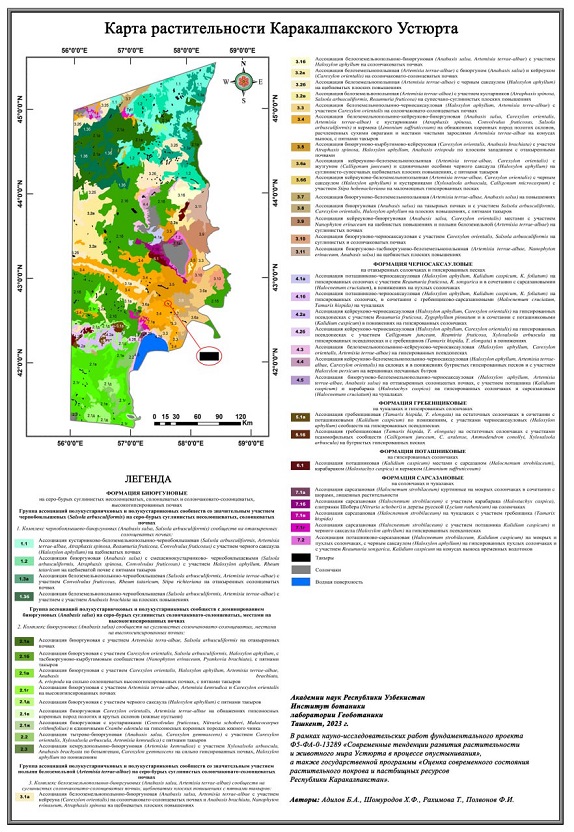
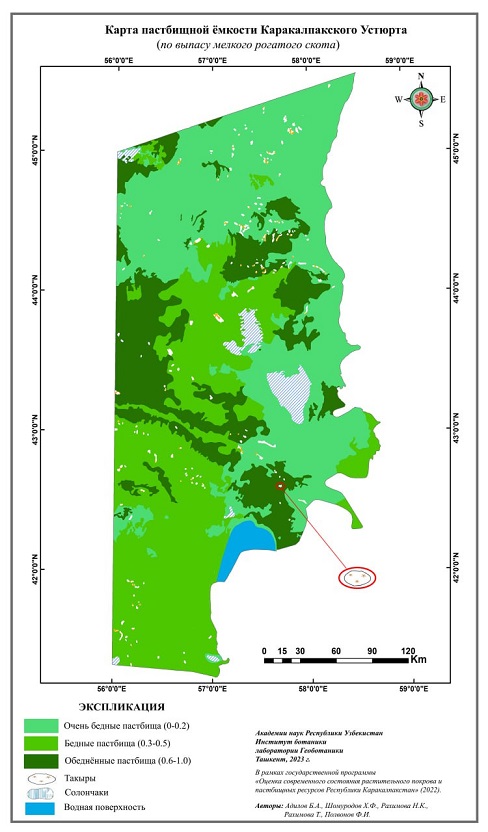
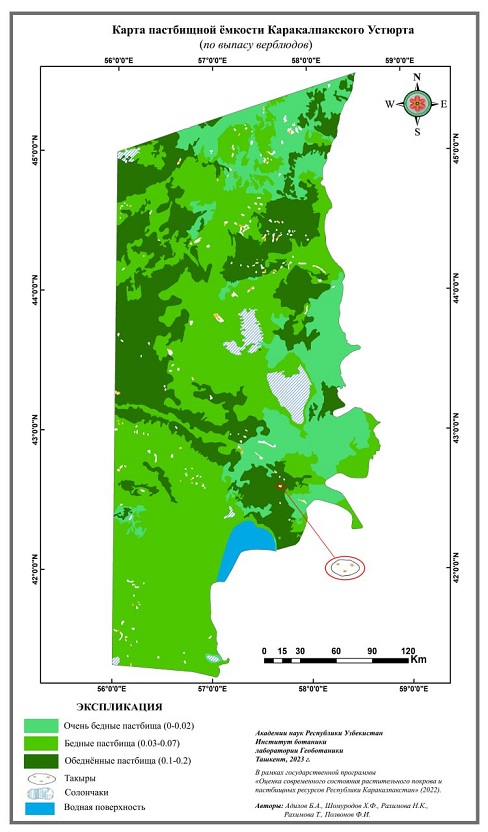
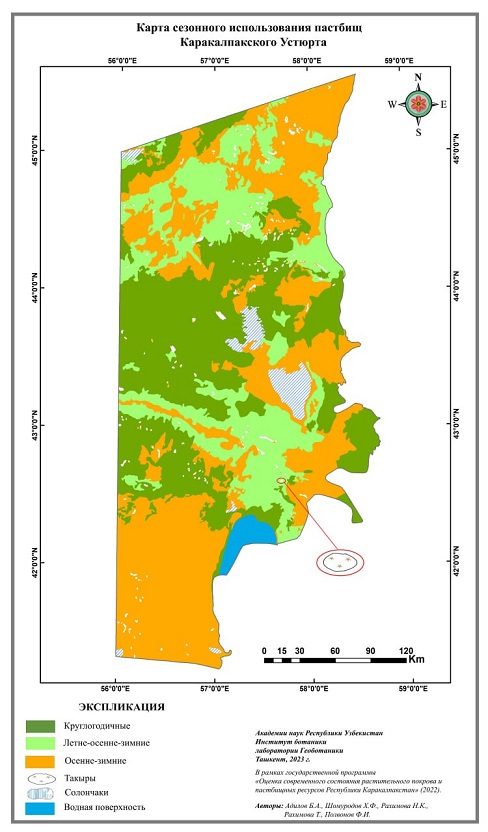
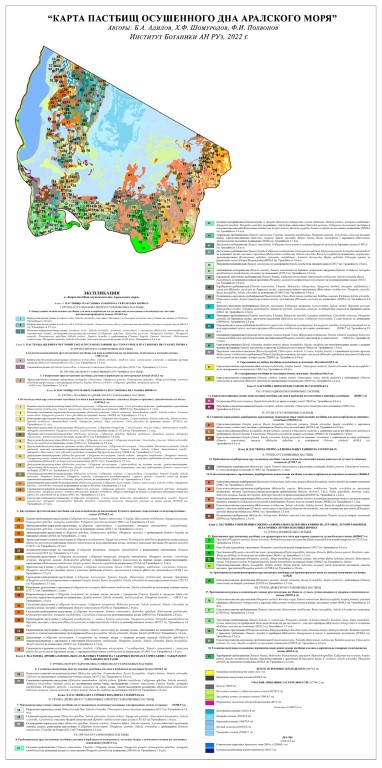
2022 – the state program “Assessment of the current state of vegetation and pasture resources of the Republic of Karakalpakstan”. In accordance with the program plan for 2022, the current state of vegetation and pasture resources of the Eastern Chink of Ustyurt was assessed. 33 pasture differences related to 13 types of Eastern Chick have been identified and their cadastre has been developed. Electronic and digital “Map of pastures of Karakalpak Ustyurt”, “Map of pasture capacity of Ustyurt”, “Map of seasonal use of pastures of Ustyurt” have been compiled. As an industrial facility, a patent (UZ SAP 02340) was obtained for the “Map of pastures of the drained bottom of the Aral Sea”.
Within the framework of the state program “Assessment of the Current State of the Vegetation Cover and Pasture Resources of the Republic of Karakalpakstan” for 2023–2024, the real range of climate anomalies in various natural-geographical zones of the Aral Sea region was identified using remote sensing data.
Based on the data obtained and analyzed through remote sensing, the correlation between these findings and actual vegetation cover indicators was assessed, considering the vulnerability of plant communities in various natural-territorial complexes.
Temporal and spatial trends in the structural changes of plant communities within the natural-territorial complexes of the Aral Sea region were identified.
A critical analysis of the complex interactions between environmental factors and pasture productivity revealed the extent to which seasonal biomass formation depends on climatic and soil factors in the Aral Sea region. For the first time, Structural Equation Modeling (SEM) was developed, integrating regression and factor analyses.
The systematization of geobotanical data recorded in the Republic of Karakalpakstan since the 1940s, with consideration of their distribution across geomorphological units, enabled the development of new approaches to geobotanical zoning of desert areas.
For the first time, based on the analysis of modern digital data, a hierarchical four-level system of habitat classification and its digital map were developed for natural and semi-natural ecosystems. This initiative, exemplified by the Republic of Karakalpakstan, is significant not only for Uzbekistan but also for Central Asia.
An inventory of pasture areas in the Republic of Karakalpakstan was conducted, and digital maps with high-precision topo-typological explications were created.
The creation of digitized vector data for pastures and the introduction of a unique methodology for processing pasture data enabled the development of a cadastral database for the pasture resources of the Republic of Karakalpakstan. This database includes a comprehensive digital information system for assessing pasture resources based on 21 parameters, including cadastral objects, plant diversity, zootechnical evaluation, economic evaluation, and management directions.
A senoflora (synanthropic flora) database for the Republic of Karakalpakstan was established.
In 2025–2026, within the framework of the “Digital Nature” program, a modern classification of the South-Western Kyzylkum pastures was developed, their productivity, seasonal use characteristics and quality indicators were determined.
During the research, the susceptibility of the Karakalpak Ustyurt and North-Western Kyzylkum pastures to climate change was assessed, and the risk of a decrease in productivity was scientifically demonstrated.
New approaches to geobotanical zoning were developed, the digital geobotanical database by region was enriched, and work continues to form a digital platform for maintaining a pasture cadastre.
Based on the created scientific and practical developments, 4 industrial design patents were obtained in 2025-2026: “Map of pastures of the Karshi desert” (SAP 2738), “Map of pastures of the North-Western Kyzylkum” (SAP 2799), “Map of capacity of pastures of the North-Western Kyzylkum” (SAP 2809) and “Map of seasonal use of pastures of the North-Western Kyzylkum” (SAP 2846).
Information about the researchers

Adilov Bekhzod Abdullaevich
d.b.s., head of the Laboratory of Geobotany
E-mail. bekhzod_a@mail.ru
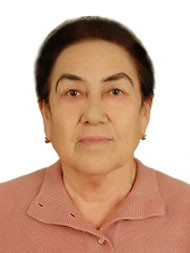
Rakhimova Tashkhanim
d.b.s., professor, leading researcher
E-mail: tashkhanimr@gmail.com

Rakhimova Nodira Komiljjnovna
DSc, leading researcher
E-mail: nr.nodiraraximova@gmail.com
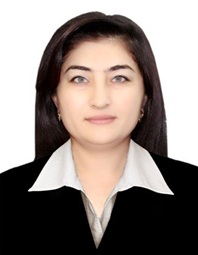
Saribayeva Shakhnoza Usanovna
Senior Researcher
E-mail: shakhnozasaribaeva@gmail.com

Sadinov Jasur Samandarovich
junior researcher
E-mail: ssjasur@mail.ru

Polvonov Farrukh Ismoilovich
junior researcher
E-mail: f.polvonov@bk.ru

Mirzambetov Allabek Nokisbayevich
junior Researcher
E-mail:

Sultamuratov Azamat Tenelbaevich
PhD student
E-mail: as.azamatsultamuratov@gmail.com

Karlibayeva Miyassar Abdinasir qizi
junior researcher
E-mail: karlibaevamiyassar@gmail.com

Elamonov Shohruh Izzatilla oʻgʻli
junior researcher
sh.elamonov2910@gmail.com
Turdiyev Quvvatbek Sharofiddin ogʻli
Loboratory worker
quvvatbek062@gmail.com
Publications (scientific articles)
- Abduraimov O., Shomurodov H., Abduraimov A. Distribution pattern and state of coenotic population of Tulipa Lehmanniana in Kyzylkum desert conditions (Uzbekistan) // American Journal of Plant Sciences, 2017. – № 8. – P. 288-296.
- Шомуродов Х.Ф., Абдураимов О.С.Онтогенетическая структура и оценка состояния ценотических популяций Tulipa borszczowii (Liliaceae) в Узбекистане // Ботанический журнал. – Санкт-Петербург, 2017. – Т. 102. – №8. – С. 1123-1136.
- Rakhimova Tashkhanim, Rakhimova Nodira, Shomurodov Khabibullo, Adilov Bekhzod, Sharipova Vasila.The current situation of coenopopulation of Lepidium subcordatum et Vved. (Brassicaceae) in relict mountains Kyzylkum (Uzbekistan) // American Journal of Plan Sciences, – № 13 (9), 2018. –Р. 2612-2625.
- Adilov B., Rakhimova T., Shomurodov Kh., Rakhimova N., Vokhidov Yu.Succession of the plant communities of the Ustyurt Eastern cliff (Republic of Uzbekistan) in connection with climate change // Journal of Environmental Protection, 2018, 9. – Р. 1408-1424.
- Ozodbek S. Abduraimov, Habibullo F. Shomurodov, Sultonkul A. Daniyarov.The Current State of Cenopopulation of Tulipa micheliana Hoog in Uzbekistan // American Journal of Plant Sciences, 2018, 9, 1725-1739.
- Khamraeva D.T., Beshko N.Yu., Abdullayeva A.T., Sharipova V.K. Structural investigation of the secretory system of some endemic and medicinal species of Apiaceae from Uzbekistan // The Iranian Journal of Botany. – 2018. – № 24 (1). – С. 52-64.
- Sharipova V.K.Comparative analysis the structure of the leaf Crataegus korolkowii (Rosaceae Juss.) сommon in two different environmental conditions // Journal of Novel Applied Sciences. – UAE. 2019. – Vol. 8. N 2. – P. 30-34.
- Rakhimova N.K., Rakhimova T., Sharipova V.K., Beshko N.Yu., Esanov Kh.K.Current state of coenopopulations of some rare species of the genus Calligonum (Polygonaceae) in the Bukhara region, Uzbekistan // Asia Life Sciences. – Philippinе, 2020. 29 (1). – P. 365-378.
- Эсанов Х.К., Шарипова В.К.Дополнение к флоре Бухарской области (Узбекистан). Turczaninowia 23, 1. – C. 126-128. DOI: 10.14258/turczaninowia.23.1.13 http://turczaninowia.asu.ru.
- Rajabov T., Ramsey D., Mardonov B., Nasirov M., Rakhimova T. &Valiev Sh.Sensitivity of Landsat 7&8-derived vegetation indices on semi-arid rangelands of southwestern Uzbekistan // Geocarto International. Published online: 11 Feb 2020. – P. 1-16. https://doi.org/10.1080/10106049.2020.1723715.
- Akopian J.A., Ghukasyan A.G., Shomurodov Kh.F., Adilov B.A.On some medicinal plants of Chenopodiaceae family in the floras of Armenia and Uzbekistan. // National Academy of Sciences of RA Electronic Journal of Natural Sciences, 2020. 1 (34). P. 12-17.
- Otso Ovaskainen, Evgeniy Meyke, Coong Lo, Gleb Tikhonov, Maria del Mar Delgado, Tomas Roslin, Eliezer Gurarie, Marina Abadonova, Ozodbek Abduraimov et al.Chronicles of nature calendar, a long-term and large-scale multitaxon database on phenology. Scientific data. (2020) 7:47 https://doi.org/10.1038/s41597-020-0376-z.
- Li W., Abduraimov O., Guan K., Feng Y.Pedicularis multicolor (Orobanchaceae), a new replacement name for the Pedicularis inconspicua. Phytotaxa (2020). 437 (2): 118–118.
- Ozodbek S. Abduraimov, Habibullo F. Shomurodov, Sultankul A. Daniyarov, Odilbek T. Mamatkasimov, Muxriddin I. Teshaev.Distribution and current state of rare and endangered Tulips (Liliaceae) arid zones of Uzbekistan // American Journal of Plant Sciences, 2020, 11, 736-744.
- Li W., Tojibaev K., Hisoriev H., Shomurodov Kh., Luo M., Feng Y., Ma K.Mapping Asia Plants: Current status of floristic information for Central Asian flora. Global Ecology and Conservation 24 (2020) https://doi. org/10.1016/j.gecco.2020.e01220.
- Ozodbek S. Abduraimov, Shomurodov H.F.,Daniyarov S.A., Abduraimov A. A. Ontogenetic Structure of Ceоnopopulations of Tulipa korolkowii Regel in Uzbekistan Journal of Botanical Research, Singapore Volume 02, Issue 04, October 2020 P.7-11
- Uktam E. Khujanazarov, Habibullo Shomuradov & Elena A. Afonina Modern condition of coenopopulation of Eremurus robustus Regel (Xanthorrhoeaceae) in Kashkadarya Basin, Uzbekistan. Asia Life Sciences. – Philippinе, 2019. 29 (1). – P. 681-686.
- Khujanazarov U.E, Habibullo Shomuradov, Sadinov J.S, Xidirova M.A.Modern Condition of Coenopopulation of Tulipa fosteriana W. Irving in Southern Part of Uzbekistan. American Journal of Plant Sciences, 2020, 11, 832-837.
- Xuehong Xu, Wenjun Li, Khabibullo F Shomurodov, Ozodbek Abduraimov, Shukui Niu.Thesium longiperianthium (Santalaceae), a new replacement name for brevibracteatum P.C.Tam Biodiversity Data Journal 8: e59007 doi: 10.3897/BDJ.8.e59007
- Rakhimova T., Rakhimova N.K., Shomurodov Kh.F. & Abduraimov O.S. Ontogenetic structure of rare plant spesies on the Usturt Plateau in Uzbekistan. Arid ecosystems. Vol. 10. № 3. P. 238-243, 2020. DOIhttps://doi.org/10.1134/S2079096120030075
- Adilov B., Shomurodov Кh., Fan L., Kaihui L.I., Xuexi M.A., Yaoming L.I. Transformation of vegetative cover in the eastern chink of the Ustyurt Plateau as a consequence of the Aral Sea desiccation // Journal of Arid Land. https://doi.org/10.1007/s40333-020-0077-7 (accepted) (Springer 1.89, Scopus, IF 3.3).
- Adilov Bekzod, Shomurodov Habibullo, Fan Lianlian, Li Kaihui, Ma Xuexi, Li Yaoming. Transformation of vegetative cover on the Ustyurt Plateau of Central Asia as a consequence of the Aral Sea shrinkage. J Arid Land (2021) 13(1): 71–87. https://doi.org/10.1007/s40333-020-0077-7
- Kh.F. Shomurodov, O.S. Abduraimov and B.A. Adilov. Assessment of the State of Tulipa lehmanniana Mercklin Populations Under the Conditions of the Kyzylkum Desert. Arid Ecosystems, 2021, Vol. 11, No. 1, pp. 83–90.
- Habibullo F. Shomurodov, Shakhnoza U. Saribaeva, Ozodbek S. Abduraimov, Rizamat Sh. Khayitov, Asilbek F. Sayfullaev. The Current State of Iris Hippolyti’s (Vved.) Kamelin Population in Uzbekistan. Annals of R.S.C.B., ISSN:1583-6258, Vol. 25, Issue 4, 2021, P. 6589-6597.
- Tashkhanim Rakhimova, Gulizebo B. Vaisova, Nodira K. Rakhimova, Anora Matkarimova. Phytocoenotic Distribution of Capparis spinosa L. (Capparaceae) Under Different Ecological Conditions in Uzbekistan. Annals of R.S.C.B., ISSN:1583-6258, Vol. 25, Issue 6, 2021, Pages. 7882-7895
- Akbar Akhmedov, Ido Rog, Amit Bachar, Habibullo Shomurodov, Muhtor Nasirov, Tamir Klein. Higher risk for six endemic and endangered Lagochilus species in Central Asia under drying climate. Perspectives in Plant Ecology, Evolution and Systematics 48 (2021) 125586
- Adilov B.А., Shomurodov Kh.F., Polvonov F.I., Eshmuratov R.А., Tamambetova Sh. Changes in the Biomass of Vegetation in the Aral Sea Region // International Journal of Multidisciplinary Research and Analysis, 2021. Vol. 04. P. 676-683.
- Rakhimova N.K., Rakhimova T., Adilov B.A., Tamambetova Sh.B. and Polvonov F.I. Current condition of Crambe edentula Fisch.&C.A. Mey. ex Korsh. on the Ustyurt Plateau in Uzbekistan // Arid Ecosystems. Vol.11, No.4, pp. 377-382.
- Feruza U. Mustafina, Hayan Lee, Vasila K. Sharipova, Andosung Lee, Dae Wook Kim, Mi Na Choi, Jeong Won Jang, Yeong-Su Kim. Comparative fruit morphology and its systematic significance in Ferula (Apiaceae) species from different growth habitats // Flora.
- Shakhmurova G.A., Rakhmatov U.E. & Saidjanova U.Sh. A complex of entertaining tasks and exercises on Biology as one means of enhancing the cognitive skills of students // Asia Life Sciences 30(1 & 2): 87-97, 2021
- Pei-Liang Liu, Wei Shi, Jun Wen, Shomurodov Khabibullo, Borong Pan. A phyligeny of calligonum L. (Polygonaceae) yields challenges to current taxonomic classifications. Acta Botanica Brasilica. Doi:10.159/0102-33062020abb0116
- Shomurodov Kh, Rakhimova T., Adilob B., Beshko N. Current Status of Vegetation of the Dried Bottom of the Aral Sea. Biodiversity, Conservation and sustainability in Asia: Volume II: Prospects and Challenges in South and Middle Asia. 2021.
- Тожибаев К.Ш., Рахимова Т.Т., Хасанов Ф.О., Бешко Н.Ю., Рахимова Н.К. Институту ботаники Академии наук Республики Узбекистан 80 лет // Turczaninowia, 2021, 24 (2).
- Shomurodov Kh., Rakhimova T., Adilov B., Beshko N., Karimov F. and Polvonov F. Current state of vegetation of the dried bottom of the Aral Sea. Environmental transformation and sustainable development in Asian region. IOP Conf. Series: Earth and Environmental Science 629(2021) 012085 doi:10.1088/1755-1315/629/1/012085
- Khujanazarov U., Shomurodov H., Mirkhamidova P. and Alimova R., Current state of Cenopopulations Iris Magnifica Vved and Tulipa Fosteriana W.Irving in Uzbekistan. E3S Web of Conferences 244, 02027 (2021).
- Рахимова Н.К., Рахимова Т. Современное состояние чернобоялышево-биюргуновых пастбищ Каракалпакского Устюрта (Узбекистан) // Аридные экосистемы. Том 28, № 3 (92). 2022. – С. 62-68. DOI: 10.24412/1993-3916-2022-3-51-61 (Scopus CiteScore 1.1)
- Saitjanova U.Sh., Shomurodov Kh. F. The impact of changes in climatic factors of the Aktumsuk region on the formations of Medicageta sativae”// Plant science today. Special issue of «Climate Resilient Agriculture». Vol. 9 NO. sp3. (2022) DOI: https://doi.org/10.14719/pst.1862 (Scopus CiteScore 1.1)
- Sharipova V.K., Rakhimova T., Rakhimova N. K. Ecological state of some pasture differences of Haloxylon ammodendron of Karakalpak Ustyurt (Uzbekistan). E3S Web of Conferences, Yogyakarta, Indonesia, 2022. Vol. 361, 04028, IConARD 2022. https://doi.org/10.1051/e3sconf/202236104028 (Scopus CiteScore 0.8, WoS)
- Nodira K. Rakhimova, Tashkhanim Rakhimova, Jasur S. Sadinov. Сurrent state of Anabasis salsa pasture varieties in Karakalpak Ustyurt (Uzbekistan) due to Aral Sea drying // Plant sciences today. 2022; Vol.9(sp3):25-30. https://doi.org/10.14719/pst.1804 (Scopus CiteScore 1.1)
- Rakhimova N.K., Rakhimova T., Shomurodov H.F., Adilov B.A., Sharipova V.K., Saitjanova U.Sh., Khabibullaev B.Sh., Sadinov J.S., Polvonov F.I., Sultamuratov A.T. (2023) Assessment of the current state of rangelands in Karakalpak Ustyurt, Uzbekistan. Biodiversitas. 24 (7) P. 3835-3843. DOI: 10.13057/biodiv/d240722 (Scopus CiteScore=2.2)
- Rakhimova N.K., Rakhimova T., Shomurodov Kh.F., Sharipova V.K. (2023) The status of coenopopulations of Xylosalsola chiwensis (Popov) Akhani & Roalson and Scorzonera Bungei Krasch. & Lipsch. on the Ustyurt Plateau (Uzbekistan). Arid Ecosystems. 13 (2). P. 189-195. DOI:10.1134/S2079096123020117 (Scopus CiteScore=1.1; WOS IF=0.8)
- Rakhimova N.K., Shomurodov H.F., Sharipova V.K., Saitjanova U.Sh., Sadinov J.S. (2023) Using biodiversity indices to assess the current state of tugai vegetation of the Amu Darya River, Uzbekistan. Biodiversitas. 24 (1) P. 467-472. DOI: 10.13057/biodiv/d240153 (Scopus 2.2)
- Shahid S, Asad F, Hussain F, Yaseen T, Dilawar N, Ahmad I, Sharipova V. (2023). Effect of serine on growth and biochemical constituents of Zea mays L., Triticum aestivum L., and Abelmoschus esculentus L. under arsenic toxicity. Advancements in Life Sciences, 10 (3): 398-405. (Scopus CiteScore=1.3; WOS IF=1.6)
- Shomurodov Kh.F., Rakhimova N.K., Saitjanova U.Sh., and Zhao Zhenyong. The ecological-phytocenotic characteristics of Halocnemum strobilaceum (Pall.) Bieb. Grasslands on the Ustyurt plateau in Karakalpakstan. Arid ecosystems. Vol. 13. № 4. P. 507-517, 2023 DOI: 10.1134/S2079096123040145 (Q2)
- Rakhimova T., Rakhimova N.K., Sharipova V.K., Rakhimova N.K., Temirov E.E. Phytocoenotic Distribution of Hulthemia persica (Michx. ex C. Juss.) Bornm. (Rosaceae) Under Different Ecological Conditions in Uzbekistan. Plant Science Today, 2024, 11 (1), 626-633. https://doi.org/10.14719/pst.2533 (Scopus CiteScore=1.4)
- Sharipova V.K., Rakhimova N.K., Rakhimova T., Sadinov Zh. Current state of mixed-Calligonum (Calligonum L.) type of pastures in North-Western Kyzylkum (Uzbekistan) E3S Web of Conferences Volume 537 (2024) 03002. Ekaterinburg, Russia, April 24-26, 2024. https://doi.org/10.1051/e3sconf/202453703002 SDEA-2024
- Rakhimova N., Shomurodov Kh., Rakhimova T., Sharipova V. Forage plants of Karakalpak Ustyurt (Uzbekistan) // E3S Web of Conferences Vol. 537, 10002. Ekaterinburg, Russia, April 24-26, 2024.
- Shomurodov Kh., Adilov B., Rudov A., Sharipova V., Abduraimov O., Khayitov R., Khabibullaev, B. Ecological aspects of distribution and population status assessment of Rhamnus erythroxyloides subsp. sintenisii (Rich.f) Mabb., a relict species in the Kyzylkum desert of Uzbekistan. Plants, 2024. 13 (22), 3154. https://doi.org/10.3390 (Scopus (Q1) CiteScore=6.5, WoS)
- Rakhimova T., Shomurodov Kh., Adilov B., Rakhimova N.K., Sharipova V.K. Current State of the Cenopopulation of Cynoglossum viridiflorum Pall. Ex. Lehm. in the Karakalpak Part of the Ustyurt Plateau (Uzbekistan). Arid Ecosystems, 2024, Vol. 14, No. 3, pp. 316-323. DOI: 10.1134/S2079096124700264.
- A.Y. Korolyuk, H.F. Shomurodov, B.S. Khabibullaev and Z.S. Sadinov Composition and Structure of Tugai: Communities in the Indication of Ecological Conditions in the Lower Amu Dar’ya. Contemporary Problems of Ecology, 2024, Vol. 17, No. 1, pp. 106–111. doi.org/10.1134/S1995425524010074 (WOS/Scopus, Q3).
- Khabibullaev B.S., Turdiboev O.A. Aleksandr Yakovlevich Butkov (1911–1981), the researcher of the flora of Uzbekistan // Botanicheskii Zhurnal. – 2024. – Vol. 109. – N. 4. – P. 412-416. doi: 10.31857/S0006813624040051 (WOS/Scopus, Q3).
- Адилов Б.А., Султамуратов А.Т., Полвонов Ф.И. Ландшафтная эволюция как фактор успешной колонизации растений на опустошённых территориях //Материалы XVII научного совещания географов Сибири и Дальнего Востока. – Иркутск: Изд-во Института географии им. В.Б. Сочавы СО РАН, 2024. – С. 60-63.
- Каримов Ф.И., Адилов Б.А., Садинов Ж.С., Полвонов Ф.И., Бегжанова Г.Т. ГИС-моделирование устойчивости растительности к изменению климата в аридной зоне Средней Азии // Материалы XVII научного совещания географов Сибири и Дальнего Востока. – Иркутск: Изд-во Института географии им. В.Б. Сочавы СО РАН, 2024. -С. 29-34.A. Karlybaeva, Sh. Kh. Rakhimova, A. A. Azamatov, L. G. Mezhlumyan, M. T. Baltabaev, B. A. Adilov & N. D. Abdullaev. Amino-Acid Composition of Proteins from Xylosalsola richteri Growing in Northwestern Kyzylkum and Under Southern Aral-Sea Conditions. Chem Nat Compd 60, 1000–1002 (2024). https://doi.org/10.1007/s10600-024-04505-1.
- “Raqamli tabiat” dasturi doirasida “Qurgʻoqchil tabiiy-geografik hududlarning ekologik axborotlashtirilgan senoflora fondini yaratish va yaylovlari kadastrining raqamli platformasini ishlab chiqish” ilmiy-tadqiqot ishlari (2025-2029 yy.)
- AL-9224104436-sonli “Orol dengizi qurigan tubi yaylovlarining raqamli kadastrini ishlab chiqish” (2026-2027 yy.)
Monographs, textbooks and recommendations
- Ашурметов А.Т. Рахимова Т.Т. Рахимова А.Т. Хикматов Ш.Х. Экология.– Тошкент: Чинор ENK, 2008.-136 б.
- Рахимова Т.Т. Рахимова А.Т. Хикматов Ш.Х. Экология.– Тошкент: Ботаника АН РУз, 2011.-136 б.
- Красная книга Республики Узбекистан. –Тошкент, 2009.
- Рекомендации по технологии возделывания полыни беловатой (Artemisia leucodes Schrenk.), продуцирующей биологически активные терпеноиды, применяемые в медицинской практике, 2011.
- Флора Узбекистана, т. 1. – Ташкент: Навруз, 2017. – 173 с.
- Ценопопуляции редких и исчезающих видов растений останцовых низкогорий Кызылкума, 2018
- Қишлоқ хўжалиги маҳсулотлари биокимёси: ўқув қўлланма. – Тошкент: Наврўз, 2018.
- Рахимова Т., Шомуродов Х.Ф., Адилов Б.А., Рахимова Н.К., Майинов Ш.Қ., Воҳидов Ю.С. Ўзбекистон чўл яйловларининг ҳозирги ҳолати ва улардан оқилона фойдаланиш: монография. – Тошкент: Ботаника институти, 2018. – 178 б.
- Ўзбекистон Республикасининг Қизил китоби, I жилд: Ўсимликлар; Тошкент: “Chinor ENK” экологикноширлик компанияси, 2019. – 356 б.
- Тожибаев К.Ш., Бешко Н.Ю., Шомуродов Х.Ф., Кодиров У.Х., Тургинов О.Т., Шарипова В.К. Кадастр флоры Узбекистана Кашкадарьинская область.–Ташкент: Издательство Фан, 2019. – 256 с.
- Тожибаев К.Ш., Бешко Н.Ю., Шомуродов Х.Ф. с участием Абдураимова О.С., Адилова Б.А., Ахмедова А.К., РахимовойТ., Рахимовой Н.К., Сарибаевой Ш.У., Хайитова Р.Ш., Шариповой В.К. Кадастр флоры Узбекистана: Навоийская область. – Ташкент: Фан, 2019. – 216 с.
- Флора Узбекистана, т. 3. – Ташкент: Маънавият, 2019. – 201 с
- Тожибаев К.Ш., Бешко Н.Ю., Шомуродов Х.Ф. с участием Абдураимова О.С., Адилова Б.А., Рахимовой Т., Рахимовой Н.К., Сарибаевой Ш.У., Хабибуллаева Б.Ш., Хайитова Р.Ш., Шариповой В.К., Эсанова Х.К. Кадастр флоры Узбекистана: Бухарская область. – Ташкент: Фан, 2020. 160 с.
- Тожибаев К.Ш., Бешко Н.Ю., Шомуродов Х.Ф. с участием: Абдураимова О.С., Адилова Б.А., Рахимовой Т., Рахимовой Н.К., Полвонова Ф.И., Сарибаевой Ш.У., Хабибуллаева Б.Ш., Хайитова Р.Ш., Шариповой В.К., Эсанова Х.К.. Кадастр флоры Узбекистана: Бухарская область.- Ташкент: O’qituvchi, 2020. – 128 с.
- Олонова М.В., Гудкова П.Д., Шомуродов Х.Ф., Адилов Б.А., Рахимова Н.К, Хабибуллаев Б.Ш., Полвонов Ф.И. Турларнинг биоиқлим моделини яратиш: амалий ишлар учун топшириқ ва уларнинг бажарилишига оид методик кўрсатма. – Тошкент: Ботаника институти, 2021. – 112 б.
- Шарипова В.К.. Структурная адаптация растений к аридным условиям произрастания: методическое руководство для проведения лабораторных занятий по ботанике в высших учебных заведениях. – Ташкент, 2021. – 66 с.
- Xo‘janazarov O‘.E., Mavlonov X., Sadinov J.S. BOTANIKA (o‘simliklar sistematikasi). – Toshkent: TDPU, 2021 yil. – 422 b.
- Alimova R.A., Mirxamidova P., Sagdiyev M.T., Adilov B.A. O’simliklar biokimyosi. Darslik. – Toshkent: Navro’z, 2021. – 400 b.
- A.Ahmedov, S.Burxonov, J.S. Sadinov, J.Qo‘nishev “Biologiya (Boshlang‘ich saboqlar)”. Darslik. OOO “Zamin-nashr”, 2021 yil. 264 bet.
- Shomurodov X.F., Raximova T., Adilov B.A., Raximova N.K., Sharipova V.Q., Habibullayev B.Sh. Polvonov F.I. Saitjanova U.Sh. Sadinov J.S. Кадастровые данные биюргуновых пастбищ Каракалпакского Устюрта. Ma’lumotlar bazasi. O‘zbekiston Respublikasi Adliya vazirligi № BGU 00680 02.07.2022 y.
- Shomurodov X.F., Raximova T., Adilov B.A., Raximova N.K., Sharipova V.Q., Habibullayev B.Sh., Sadinov J.S., Polvonov F.I., Saitjanova U.Sh. Тугайные леса Узбекистана. Ma’lumotlar bazasi. O‘zbekiston Respublikasi Adliya vazirligi № BGU 00737 23.08.2022 y.
- Sharipova V.Q., Shomurodov X.F., Raximova T., Adilov B.A., Raximova N.K., Habibullayev B.Sh., Polvonov F.I. Saitjanova U.Sh., Sadinov J.S., Sultamuratov A.T., Kairbayev A.Sh. Orol dengizi qurigan tubining o‘simliklar qoplami va florasi. Ma’lumotlar bazasi. O‘zbekiston Respublikasi Adliya vazirligi № BGU 00978. 07.03.2023 y.
- Toderich, Kristina & Matsuo, Naoko & Khujanazarov, Temur & Shomuradov, Khabibullo & Yamanaka, Norikazu & Tanaka, Kenji & Nishonov, Bakhriddin & Adilov, Bekhzod & Kholmatjanov, Bakhtiyar. (2024). Halophytes of the Aralkum Saline Desert.
- Adilov B., Shomurodov Kh., Rakhimova T., Sultamuratov A., Polvonov F., Begjanova G., Jabbarov Z., Wang L., Zhao Z. Vegetation colonization and biodiversity dynamics on the exposed Aral Sea bed: A 35-year investigation. Ecological Indicators. 2025. 177: 113789. https://doi.org/10.1016/j.ecolind.2025.113789 (Scopus Q1)
- Sharipova V.K., Rakhimova T., Rakhimova N.K., Shomurodov Kh.F., Adilov B.A., Sadinov Zh.S. The current state of white saxaul pastures in Northwestern Kyzylkum related to desertification. Arid Ecosystems. 2025. 31(3): 82–92. (Q3)
- Saribaeva Sh.U., Shomurodov Kh.F., Adilov B.A., Khabibullaev B.Sh., Sadinov J.S. Analysis of Glycyrrhiza glabra L. coenopopulations in the Amudarya River basin under global climate change. Plant Science Today. 2025. doi:10.14719/pst.3445
- Adilov B., Shomurodov Kh., Rakhimova T., Sultamuratov A., Polvonov F., Begjanova G., Jabbarov Z., Wang L., Zhao Z. Vegetation colonization and biodiversity dynamics on the exposed Aral Sea bed: A 35-year investigation. Ecological Indicators. 2025. 177: 113789. https://doi.org/10.1016/j.ecolind.2025.113789 (Scopus Q1)
- Sharipova V.K., Rakhimova T., Rakhimova N.K., Shomurodov Kh.F., Adilov B.A., Sadinov Zh.S. The current state of white saxaul pastures in Northwestern Kyzylkum related to desertification. Arid Ecosystems. 2025. 31(3): 82–92. (Q3)shkent: Voris nashriyot, 2026.-398 b.
- Saribaeva Sh.U., Shomurodov Kh.F., Adilov B.A., Khabibullaev B.Sh., Sadinov J.S. Analysis of Glycyrrhiza glabra L. coenopopulations in the Amudarya River basin under global climate change. Plant Science Today. 2025. doi:10.14719/pst.3445